
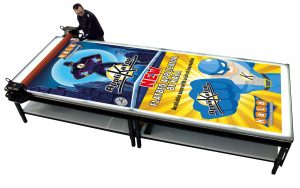
A flatbed laminator is a work table with a pressure roller that travels across it. Instead of feeding material through a pair of rollers, you lay the print, film or board on the table and bring the roller over it. That makes it well suited to applying graphics to rigid boards, laminating with film, and mounting, all on one surface. If you are weighing film against liquid lamination, our comparison of liquid and film lamination sets out the differences.
About the Kala Applikator
Landor supplies the Kala Applikator flatbed laminator. Kala also makes film laminators, X/Y cutters and heat presses. Features of the Applikator include:
- No compressor needed, so there is no separate air supply to install.
- Three pressure settings to suit different materials.
- A roller safety sensor.
- A media wind shaft for applying, laminating and mounting rolls and application tape.
- A modular table that can be extended, with under-table storage.
- An optional integrated light box, useful for checking registration and spotting flaws.
Full specifications are available from Landor and on our equipment page.
Setting up
Site the table in a clean area with room to walk around it and to lay out boards and rolls. Dust is the main cause of specks and bubbles under film, so keep cutting and packing away from the laminator. Read the manufacturer’s manual before first use, and make sure everyone who will operate the machine understands the safety features, including the roller safety sensor, and how to stop the roller.
A first job: mounting a print to board
- Clean the table and roller with a lint-free cloth.
- Check the print is fully dry and that the board and adhesive suit the print media.
- Choose a pressure setting suited to the materials, following the machine manual and the media guidance. Try it on scrap first.
- Place the board on the table and dust its surface.
- Position the adhesive-backed print along the leading edge, peel back a short section of liner and tack the edge down.
- Bring the roller onto the tacked edge, then advance it steadily while peeling the liner away beneath, keeping slight tension on the print.
- Inspect the result, ideally over the light box if fitted, before trimming.
Building confidence
Practise on offcuts before working on customer prints. Common early problems are creases, which usually come from uneven tension, and silvering or bubbles, which point to dust or too little pressure. Using the wind shaft to feed laminate or application tape from the roll keeps tension more even than handling loose sheets. Keep notes of the settings that work for each combination of media and board, so the next job starts from a known point.
If you would like to see whether a flatbed laminator suits your workload, speak to Landor on 01252 624 411 or arrange a conversation through our contact page.