
Print shops often ask which is better: liquid lamination or film. The honest answer is that each does a different job well, and many businesses use both. This guide sets out the practical differences so you can match the method to the work in front of you.
The basic difference
Film lamination bonds a pre-made sheet of clear film to the print, using pressure-sensitive adhesive or heat. Liquid lamination applies a coating by roller, spray or coating machine, which dries into a clear layer on the surface. One adds a separate material on top; the other becomes part of the print.
Finish and appearance
Liquid coatings follow the surface of the media, so the weave of a canvas or the tooth of a fine art paper remains visible. That matters to photographers and artists who chose the media for its character. Film tends to flatten texture and gives a more uniform, manufactured look, which can be exactly what a retail graphic or menu board needs.
Protection
Both methods protect against moisture, scuffing and handling. A coating such as Colourjet protects against water, chemicals and abrasion and includes UV inhibitors to help limit premature fading. Film provides a thicker physical barrier, which can be useful for floor graphics, heavily handled items or graphics that need extra rigidity. Where impact resistance is the main concern, film is often the stronger choice.
Workflow
- Film: clean and immediate to handle once laminated, with no solvent vapour. The main risks are trapped dust, bubbles, silvering and edge lift, and it needs a laminator for anything beyond small sizes.
- Liquid: needs a ventilated area and drying space, and solvent coatings must be handled in line with the safety data sheet. It suits very wide, oversized or irregular work and avoids film waste at the edges.
Compatibility
Film adhesives can struggle on heavily textured surfaces and some uncoated media. Solvent coatings, for their part, do not suit every ink and substrate, and some combinations can show colour shift or surface change. In both cases, test on a sample of the actual media and ink before running a job. Our compatibility guidance covers what to check.
A quick way to decide
- Canvas, fine art paper or textured media where the surface should show: liquid.
- Wallpapers and very large panels: liquid is often more practical.
- Floor graphics or items needing a thick, tough barrier: film.
- Flat, smooth graphics for mounting on board: either, depending on finish and volume.
- Mixed work: many shops keep both to cover the full range.
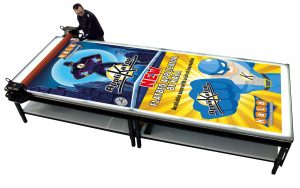
Landor supplies both routes: liquid coatings and coating machines, and the Kala Applikator flatbed film laminator, which needs no compressor and offers three pressure settings, a roller safety sensor and a modular, extendable table. You can see them on our equipment page.
Not sure which way to go for a particular job? Ring 01252 624 411 and describe the work, or get in touch online, and we will give you a straight answer.