
Protection is usually the reason people coat a print, but the finish is what the client notices. The same image can look punchy, restrained or painterly depending on how much light the surface reflects. Choosing the finish deliberately, rather than defaulting to whatever is on the shelf, is one of the easiest ways to improve the result.
What each finish does
Gloss
Gloss gives the deepest blacks and the most saturated colour, because less light is scattered at the surface. It suits photography, bold retail graphics and anything meant to catch the eye. The trade-off is reflection: under spotlights or opposite windows, gloss can show glare and makes surface marks and dust more visible.
Semi-gloss and satin
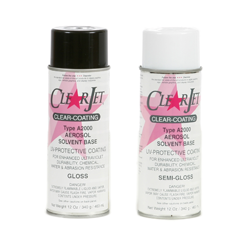
A middle ground. Colour stays rich but reflections are softened, which makes it a safe choice for portraits, wall prints, canvas and corporate interiors. ClearJet aerosols come in both gloss and semi-gloss, which covers many everyday jobs; see ClearJet.
Matte
Matte finishes reduce glare almost entirely and give a soft, even look. They suit fine art, text-heavy signage, wayfinding and anything viewed under harsh or changing light. Blacks will appear lighter and colours a little quieter than under gloss. If a matte finish is important to the job, ask us which of our coatings will give the result you want.
Matching finish to situation
- Brightly lit retail, spotlights or windows: consider semi-gloss or matte to cut reflections.
- Gallery photography viewed close up: gloss or semi-gloss for depth.
- Textured canvas and wallpaper: semi-gloss usually keeps the texture readable without glare.
- Signage read at a distance: lower sheen helps legibility from different angles.
The media changes the outcome
A coating does not sit on a blank slate. Gloss on a matte paper will not look like a gloss photo paper; it will look like coated matte paper, often with some of the texture still showing. Heavily textured media will always scatter some light, whatever the coating. Application method also affects final sheen, so a hand-rolled coat may look slightly different from the same coating applied by machine.
- Always make a coated sample on the actual media for client approval.
- View it in lighting similar to the final location.
- Keep the method consistent across a job so panels match.
You can compare all our coating options on the coatings page.
Torn between two finishes? Send us your print and we can coat samples in each, or call 01252 624 411 for a quick recommendation.