
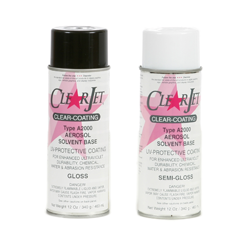
An aerosol is the simplest way to put a protective coat on a print. There is nothing to set up or clean, and it reaches into textured surfaces that a roller can skip over. ClearJet aerosol coatings are available in gloss and semi-gloss, which makes them a convenient choice for single prints, small editions, touch-ups and jobs where buying spray equipment would not be justified.
Where aerosols work well
Aerosols are best suited to smaller pieces: art prints, photographs, canvas wraps and point-of-sale items. On very large prints it becomes difficult to keep the coat even and the job can use a lot of cans, so a roller, HVLP spray system or coating machine is usually more practical.
Before you spray
- Work in a well-ventilated space, ideally a spray booth or an area with extraction, and away from any ignition source.
- Read the safety data sheet and wear the PPE it lists, typically including suitable respiratory protection and gloves.
- Make sure the print is fully dry. Coating a print that is still outgassing can trap solvents and cause defects.
- Bring the can and the print to normal room temperature. Cold cans tend to spit and give an uneven spray.
- Test on an offcut of the same media and ink first.
Spraying technique
- Shake the can thoroughly as directed on the label.
- Fix the print upright or flat, depending on what you find easier to control. Upright reduces dust settling; flat reduces the risk of runs.
- Do a short test burst onto scrap card to check the spray pattern is clean.
- Start spraying off the edge of the print and move across in a steady, straight line, keeping the can at a consistent distance as given on the label.
- Release the nozzle only once you are past the far edge, then return in the opposite direction, overlapping each pass by around a third to half.
- Apply a light coat first. Several thin coats give a better finish than one heavy one.
- Allow each coat to dry as directed before the next, and consider spraying the next coat at right angles to the last for even coverage.
- When finished, clear the nozzle according to the can’s instructions so it is ready for next time.
Common problems
Runs and sags come from holding the can too close, moving too slowly or applying too much at once. Dry, gritty patches usually mean the can was too far away, so the spray was partly dry before landing. Blotchy gloss can follow from uneven overlaps. In each case, slow and steady with consistent distance is the fix.
Gloss or semi-gloss?
Gloss deepens blacks and makes colours look more saturated, but reflects more light. Semi-gloss is a little more forgiving under gallery or shop lighting. If you are unsure, spray a sample of each and view them in the lighting where the print will hang. You can find both versions on our ClearJet page, and our guide to choosing a finish goes into more detail.
To order ClearJet or ask about a specific media, phone 01252 624 411 or message the team.