
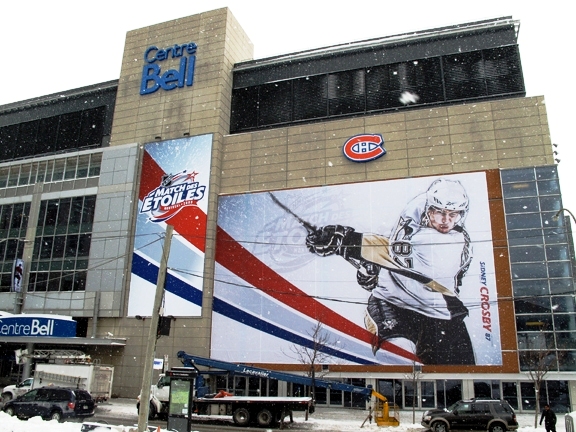
Banner is the everyday material of outdoor advertising: event signage, building wraps, scaffold and construction hoardings, shopfront promotions and exhibition backdrops. Most banner work is printed on eco-solvent, solvent, latex or UV printers and goes out uncoated. So when is a coating worth the extra step?
When to consider coating
- Banners that will be up for a long period in direct sunlight, where extra UV protection helps slow fading.
- Banners that will be reused, rolled and unrolled for repeat events, where abrasion is the main problem.
- Graphics at street level that will be touched, cleaned or exposed to traffic grime.
- Jobs where the client wants a particular surface finish.
Film lamination is rarely practical on large banners because of their size, weight and flexibility. A liquid coating such as Colourjet, which protects against water, chemicals and abrasion and includes UV inhibitors, is often the more workable option.
PVC banner
Traditional PVC banner contains plasticisers that keep it flexible. Over time these can migrate towards the surface, and that can affect how well a coating stays bonded. Solvent inks are also absorbed into PVC to some degree, so the print needs to dry and outgas fully before coating. Test adhesion on a sample, ideally after it has been rolled and unrolled a few times.
PVC-free banner
PVC-free materials, such as polyester, polyolefin and other coated textiles, are increasingly specified for environmental reasons. Their surfaces vary considerably between makers. Some take a coating well; others are harder for coatings to bond to, or may react to solvent. Do not assume that a result on one PVC-free banner will carry across to another. Test each new material.
Practical points
- Coat before finishing, then check that welding, hemming, taping or eyeleting still works on the coated material.
- Mesh banners need care to avoid filling the holes; a light, even application is best.
- Let the coating dry fully before folding or rolling, or the surface may block and stick to itself.
- A liquid lamination machine makes large banners far more manageable than hand application.
See our coatings and liquid lamination machines for more.
Testing a new banner material? Send us an offcut with your print on it and we will report back, or speak to us on 01252 624 411.